Leash walking: who's at the wheel, not who's pulling

A walk should be the best part of the day — for you and for your dog. For many people it's exactly the opposite: an outstretched arm, a leash under constant tension, a dog that pulls, strains, sniffs everything and goes haywire at every noise — and a person who gets home more tired than if they'd gone for a run on their own.
And the explanation you hear most often is wrong from the ground up: "he pulls because he's stubborn", "he wants to be the boss", "he's dominant". It's not like that. The idea that a dog pulls on the leash to dominate you was debunked long ago — it's an old myth, just like the story of the "alpha wolf" who leads by force.
The truth is simpler and much more useful. Think of the walk as a car driving through busy city traffic: noises, other cars, other dogs, risks at every corner. You and your dog are two passengers. But the car can't go without a driver. Someone absolutely has to move into the driver's seat and take on the responsibility — and the stress — of driving it. And if you don't move over, the dog does.
It's that simple: your dog pulls because it has been left as the driver of a car it should never have to drive. The good news? The seat behind the wheel is free. All you have to do is sit down.
Why your dog really pulls
First, what it is NOT. It isn't malice, it isn't defiance, it isn't a fight over "who's boss". A dog doesn't wake up in the morning planning to show you who the master is. Pulling has a much more ordinary origin: it's what happens when the driver's seat is left empty.
Think about what the dog sees. You go out the door, and most of the time it decides everything: where we go, how fast, where we stop, what we sniff, what we bark at. The human comes along behind, dragged by the leash, reacting to what the dog chooses. In the dog's language, that means only one thing: nobody is at the wheel of the car. And a moving car with an empty driver's seat is an emergency — someone jumps behind the wheel. If you don't, it does.
And when it drives, it does exactly what a driver does who's been put behind the wheel against their will, in traffic they can't handle: it pushes ahead tensely, scans the road, checks every bush and every passer-by, tenses up at everything. It's exhausting — more for it than for you. A dog that "drives" the walk is a dog carrying the stress of the whole journey on its shoulders, not a dog having fun. It didn't ask you for the wheel; it just found nobody there.
Here's the key: pulling isn't the problem. Pulling is the symptom. The problem is the empty driver's seat. That's why you solve nothing by putting more force into your arm or shortening the leash until you're choking it — you're treating the wrong end. You can pull harder, it pulls back even harder: it's an old law, every force creates an equal and opposite force. That's how the walk turns into a tug-of-war match — a "war fought through the leash" that nobody wins.
And when you use force, something else bad happens: you take its brain out of the equation. A dog pulled by force no longer thinks, no longer learns — it just strains. That's not what you want. You don't want an opponent at the end of the leash, you want a teammate sitting calmly in the passenger seat.
Give the metaphor its full weight: a good driver doesn't grip the wheel with all their strength, doesn't jerk it, doesn't get scared at every passing car. They anticipate, steer smoothly, they're in command of the road — a lighthouse of control. On the walk, you are the driver. The leash is the steering wheel, not a tow rope. And the dog, like any passenger, calms down when it feels that someone calm and confident is at the wheel. When you get agitated too, when you pull chaotically and get frightened, you confirm to it that it's dangerous out there and that it had better take the wheel itself. Be the lighthouse-of-control driver, not a headless chicken on the walk — half of your dog's calm comes from your calm, because it reads and mirrors your state.
So the reframe is simple: the walk isn't a fight you win with your arms. It's a car you drive — and to drive it, you only need to move into the driver's seat yourself, calmly and consistently. The rest is how you get there, step by step.
See the method in practice
So that this doesn't stay just words, I've prepared a video guide in which I show step by step exactly what follows below — how you teach your dog to walk at "heel" and stop pulling. Watch it before or after you read the steps: you'll see "live" what it means to move behind the wheel.
How you move behind the wheel, step by step
The basic rule, before any technique: always from minimum to maximum. You start with the gentlest intervention and go up a level only if you've applied the level below correctly, over enough repetitions, and it hasn't worked. You don't jump straight to force — force is the last resort, not the first. The philosophy that holds it all together: minimum pressure = maximum cognitive integration. The less you intervene, the more the dog thinks and the more thoroughly it learns.
Speak the language of the walk (a few words, always the same)
A dog doesn't need speeches, it needs a few clear signals, always used the same way. Four are enough for a walk:
"Heel" ("Pas") = "line up next to my leg and let's go". It doesn't mean "slower" and it doesn't mean "don't pull" — it means "come next to me, we're setting off". Good alignment is with the dog beside you, from its nose to about its ribs; when it gets completely ahead of you, it's no longer "heel".
"Slower" ("Mai încet") = the foot brake: a short, gentle correction from the wrist when the tension rises. Short, not a long pull.
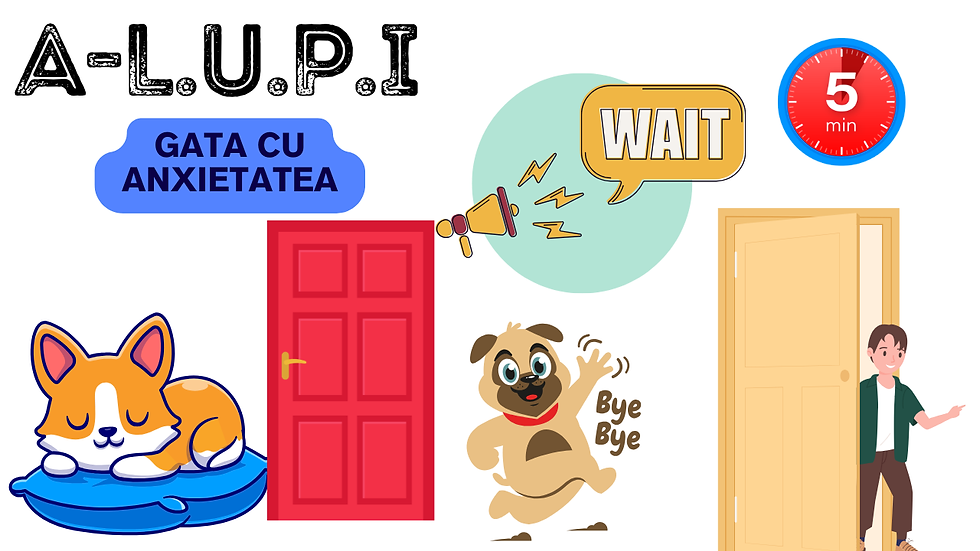
"Wait" ("Așteaptă") = the handbrake: a full stop, we stay where we are.
"Free" ("Liber") = "you have the whole leash, you can sniff, you can relieve yourself" — but only in clean, controlled areas, and only when you decide.
Go up gradually, not all at once
The idea isn't to "train" movement — the dog already knows perfectly well how to walk. The idea is to teach it to walk beside you, when you ask. It's done in stages, patiently:
First, without a leash, in the house or in the yard. You only associate the word "heel": you move around the room with a few rewards in your hand and you praise and reward it ONLY when it comes next to you. You don't run after it — it learns that next to you is the place where good things happen. The leash doesn't even come into play yet.
Then the leash, but left to drag on the ground. Just so it gets used to the feel of it, without feeling it as a brake. You praise every time it walks next to you.
Then the long leash, in your hand. You ask it for a few metres of nice walking beside you before the reward. You have the leash in your hand so you can calmly manage the moments when it wants to go haywire — without jerks.
Then the short leash, with the "stress hand". One hand holds the leash securely (it doesn't slip away from you), the other is relaxed and "fishes": when there's tension, a short correction from the wrist, "slower", and that's it. The dog's head up, and you scan the environment — you're at the wheel, you're the lighthouse. The rewards become less frequent as it understands.
Finally, the "BMW driver". No rewards, leash at the belt, you walk "like you own the road". When the dog gets distracted or pulls to one side, you change direction smoothly and carry on — it learns to pay attention to you, not the other way round. In moderation, never with a jerk. This is the moment it has moved for good into the passenger seat: you drive, it enjoys the walk.
The golden rule: foundation first
At the beginning, the right walk is about 80% disciplined walking beside you and 20% free to sniff. Not the other way round. First you build discipline and trust, then you give freedom as a reward. As the dog becomes more balanced, the proportions reverse nicely on their own — with a mature, calm dog you can get to 20% heel and 80% free, because the foundation is already in place. But foundation first. Always foundation first.
And, to be completely honest: yes, the method also has a firm "no" in its proper place and it has corrections. But they are minimal, calibrated to the dog, and never brutal. A proper correction is a short touch from the wrist and a calm word — not a jerk from the shoulder, not a squeeze that chokes. If you end up pulling on the dog's neck by force, you went wrong somewhere earlier. A leash that doesn't strangle the dog when you correct gives you precisely this: the ability to give direction without hurting.
The thread that ties it all together
Notice what doesn't appear anywhere above: the jerk, the choking, the arm straining for hours on end. Not because we're soft, but because force ruins exactly what you want to build — the dog's trust that it can sit calmly in the passenger seat, because you're at the wheel.
Everything you do on the walk builds one single thing: the dog feeling that you have the wheel. When it feels that, it gets out of the driver's seat — and a dog that no longer has to drive is a relaxed dog, one that sniffs, enjoys itself and follows you. Four things make you the driver it needs on the street:
Foresight — you see the problem (the dog, the car, another dog) before you get to it, like a driver looking far down the road.
Initiative — you decide the direction, you don't react to its direction.
Control — you stay calm at the wheel; the lighthouse, not the headless chicken.
Consistency — the same rules, the same words, every time.
These four, repeated patiently, tell the dog more than a thousand corrections.
And don't forget the unseen half of the walk: your state. The dog reads you. If you go out the door tense, in a hurry, with fear in your body, you confirm to it that it's dangerous outside and that it had better take the wheel. If you go out calm, confident, in command of the pace, you tell it without words: "relax, I'm driving, you just enjoy the walk". Minimum pressure, maximum thinking. Go patiently from the first step to the "BMW driver" — and, walk after walk, you move the dog from the driver's seat, where it never wanted to be, back into the passenger seat, where it feels good.
When the walk calls for specialist help
Honestly, as always: not everything that happens at the end of the leash can be solved with patience at home. Ordinary pulling, agitation, lack of discipline — yes, those are worked on exactly as above. But if you see something else — a dog that lunges on the leash barking, growling or attacking at the sight of other dogs or people, real panic, extreme fear, behaviour that frightens you or becomes dangerous — then it's no longer a simple matter of "who's at the wheel". Reactivity and aggression on the leash have causes that require an individual assessment, done by a behaviour specialist or, if needed, by a veterinarian. Don't start a harsh programme on your own with a dog that is already reacting out of fear — you risk adding fear on top of fear. A dog that is struggling deserves an assessment to match.
The one-minute summary
Your dog doesn't pull out of dominance or stubbornness. The walk is a car in traffic, and the driver's seat can't be left empty. If you don't move behind the wheel, the dog does, and it pulls, with all the stress of driving the car through danger. Pulling is the symptom; the empty driver's seat is the cause.
The solution isn't a shorter leash or a stronger arm (that's a "war fought through the leash", which takes the dog's brain out of the equation) — it's for YOU to move into the driver's seat: you set the direction, the pace and the rules, calmly and consistently. The leash is the steering wheel, not a tow rope.
You move behind the wheel gradually, from minimum to maximum, with a few clear words (heel / slower / wait / free) and with the golden rule "foundation first". Half of your dog's calm comes from your calm. And for reactivity or aggression on the leash — go to a specialist.
I'm not selling you any miracle leash or any trick that fixes everything in a day. I'm telling you the truth, even if it sounds different from what you've heard: the dog that drags you all over the neighbourhood isn't a bad dog and doesn't want to be your boss. It's a dog that, finding nobody at the wheel, got in to drive the car through traffic itself — and is carrying a stress that isn't its own.
Move behind the wheel yourself. Not with your arms, but with the way you walk: calm, confident, with the direction in your hands. Give it a few words it can rely on and be the driver it needs on the street. You'll see the leash slacken by itself, the dog move over to the passenger seat — and the walk become again what it should have been from the start: the best moment of the day, for both of you.
If you want to understand why everything you've read here works, the first step is KNESsence, the free material in which I've put the essence of the system we work by at KNES. Create an account on knes.ro, you'll get a six-digit code by email and go straight to it.
With care for your dog,
Petre ROMAN
This material is for educational purposes and does not replace an assessment by a behaviour specialist or a veterinarian. Reactivity or aggression on the leash — a dog that lunges barking, growling or attacking — needs an individual assessment. Don't start a harsh programme on your own with a dog that is reacting out of fear; ask for specialist help.

Comments