The dog who can't bear being left alone isn't taking revenge — it's worried about YOU

You leave home for ten minutes. You come back and find the door scratched, a cushion torn apart, maybe a puddle in the hallway. And the first thought, a human one, is: "he did it out of spite, because I left him alone".
It's not like that. Your dog isn't taking revenge — it doesn't hold grudges and it doesn't plan punishments. But let me knock down the second wrong idea too, the most widespread one: it isn't "fear of abandonment" either. It isn't suffering like an abandoned child afraid you don't love it any more. It's something completely different — and once you understand what, the whole way you help it changes.
The truth sounds strange at first: your dog isn't afraid for itself. It's afraid for YOU. And to understand why, we need to see how it got there.
Part 1 — What separation anxiety really is
First, what it is NOT. Anxiety isn't a behaviour and it isn't a whim. It's a mental state — a state of unease, of alarm. The barking, the destruction, the fear peeing, the howling: those aren't "the problem", they're just the valves through which the state escapes. That's why you solve nothing by scolding the marks on the floor — you treat the smoke and leave the fire burning.
Now, how this state is born. We humans do something without realising it: we anthropomorphise — that is, we put human thoughts and needs onto the dog. We treat it like a small, helpless child. We feed it every time it whimpers, we respond to every request, we almost ask its permission, we fuss over it like a baby that can't survive on its own. All of this sends the dog, in its own language, a message we don't even suspect: "I, the human, can't cope on my own. I need looking after".
But in a dog's head, someone has to be the leader of the pack. A pack without a leader is a pack in danger. And if you behave like someone who can't cope, the dog is pushed — without wanting it, without being made for it — into the role of leader. It becomes the guardian. It, the one carrying on its shoulders the safety of the whole pack, you included.
And here's the key that almost nobody sees: a real leader doesn't think about itself. It thinks about its own. It carries the care of the pack non-stop, it's always on guard, always keeping an eye on those in its charge. It isn't a comfortable job — it's a burden.
Now put yourself in that dog's skin. You — the "subordinate" it feels it has to protect, the one it has learned can't cope alone — open the door and leave. You go out alone into the world outside: into "the forest", "on the hunt", among cars, noises, dangers it can't even see, but suspects. What does the leader-dog feel in that moment? Not "oh, he's left me, I'm alone in the world". But: "a member of my pack has gone out alone into danger, and I can't protect him, I can't guarantee he'll come back alive — because he doesn't know how to look after himself".
That is separation anxiety. Not the fear of an abandoned child. The desperate worry of a leader for someone dear, gone into the unknown, whom it doesn't believe capable of coping. It's love and responsibility turned inside out — a dog that "works" in your absence, tormented by a worry we put on its shoulders.
The analogy that makes everything clear: imagine a parent whose five-year-old opens the door alone and goes out into town — without saying where they're going, with whom, or when they'll be back. The parent doesn't panic because they're "afraid of being left alone in the house". They panic because they can't guarantee the safety of the child who has gone out into the world. That's exactly what your dog is going through. Only the roles are reversed compared to what you think: YOU are the child who went out the door, and it is the worried parent — because you put it, without meaning to, in that role.
And it's not just my theory. Research in recent years supports the core of it: many of the dogs that suffer when left alone aren't even excessively "clingy" with their owner — a sign that we're not talking about a simple fear of being alone, but about something deeper. And that a dog reads and mirrors your state, that it truly "feels" you, is being shown more and more clearly by studies. As for the way I connect things — that its worry is that of a pack member who has you in its keeping — that's what I see in the field, year after year, in the dogs I've rehabilitated; it's my compass, tested on hundreds of cases.
There's one more detail that weighs heavily: the dog can't deduce what we take for granted. It doesn't tell itself "he's gone to work, he'll be back at six". To its mind, "I can't see you" means almost "you no longer exist" — like a very young child who believes that what can't be seen has disappeared. So in its head it isn't "wait until he comes", but "he's gone into danger and he might never come back". Hence all the torment.
What this means for the solution (and why scolding makes it worse): if the anxiety is the leader's worry for you, then the cure isn't to "punish" it, but to make it unnecessary — by showing the dog that it no longer has any reason to guard you. That you are a capable leader, who goes out into the world and comes back calm, whole, in control of the situation. When the dog sees, again and again, that you cope without it — that you're at the wheel, not it — you lift the burden off its shoulders. And a dog that no longer has to look after you has no reason to panic. (And, so you don't misunderstand me: my method has rules and has a firm "no" in its proper place — but you don't pour a hard correction onto a dog that's already panicking, because you add fear on top of worry. There, you work on safety and trust.)
That's the whole point of the protocol below. A-L.U.P.I. isn't a list of tricks to "shut the dog up" — it's the way you lift, step by step, the burden of leadership off its shoulders and hand it back to the human, where it belongs.
A useful aside — not every bit of damage is anxiety. Sometimes a dog chews out of boredom, from unspent energy, or because nobody has shown it the house rules. That's another story, with another solution. True separation anxiety has a distinctive pattern: the dog is your shadow around the house, gets agitated as soon as you start getting ready to leave (you pick up the keys, put your shoes on), and greets you on your return as if you'd been gone for a year. The shadow + agitation at the departure cues + the exaggerated greeting = its signature.
Part 2 — The A-L.U.P.I. protocol, step by step
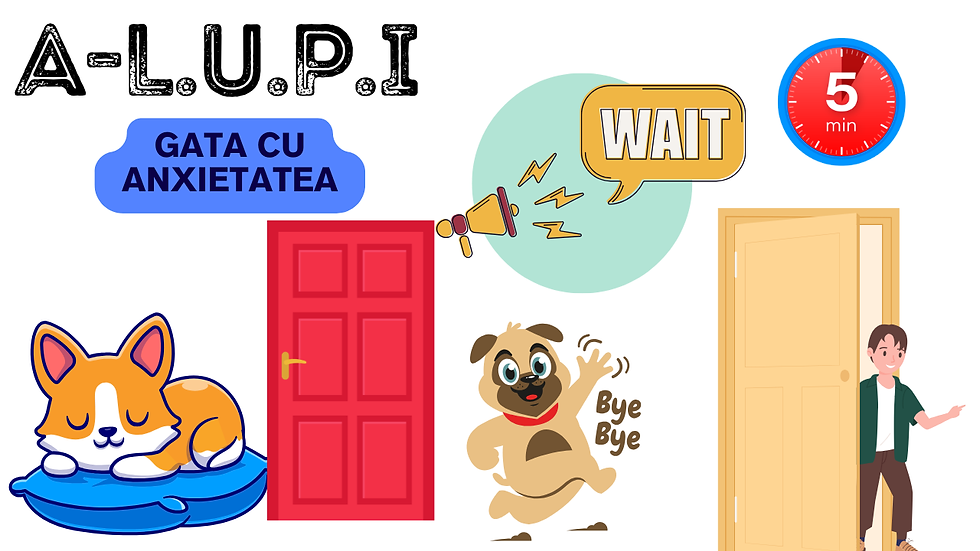
Five steps. Their names are also the order: Wait (Așteaptă), Place (La loc), Doors (Ușile), Leaving (Plecarea), Coming in (Intrarea). Each step does one big thing: it shows the dog that it can rely on you as a leader and that it no longer has to guard you. Take them one at a time.
A — Wait (teach it patience: from impulse to the thinking mind)
Simply put: you teach the dog to stay calm when it doesn't immediately get what it wants. It seems unrelated to being left alone — but it's the foundation. A dog that can't bear three seconds of waiting at the bowl won't bear three hours until you get home.
Why it matters: its brain has two speeds — an impulsive one, which wants it now, and one that thinks and controls itself. "Wait" moves it from the first to the second. Our mind is like a modern TV, it switches on instantly; the dog's is like the old valve TVs — it has to warm up before the screen lights up. "Wait" gives it time to light up.
Concretely:
Patience in time. At mealtime, you ask for "Sit", say "good" straight away, then count in your head before giving it the kibble: first two seconds, then four, eight, ten, longer and longer. This way it learns that, if you've said it, the reward is sure to come — it gains trust in your word.
Patience in space. On a mat, you say "Wait", take a step and look at it: if it stays, you go back, "good", reward. You increase the distance across three levels: first it can see you, then you're out of the room but reachable, then gone and "nowhere to be found". To it, "I can't see you" means almost "you don't exist" — that's why you build up slowly.
And these aren't done once. A dog isn't a computer you install a program on. You repeat them — daily at first, later once every few days, then once a week — but you repeat them.
L — Place (give it a corner all its own — and link it to "sleep")
Simply put: the dog has a fixed place — a bed, a blanket — where it learns that it's good, it's safe, it rests. The place is always POSITIVE. Never the place where you scold it. If until now its bed has also been the place of punishment, swap it for a new one, linked only to good things.
Concretely: you calmly take it to its place (on the leash if needed), "good", reward, until it goes on its own; then you send it from a few steps away; then from another room. And you add a trick that works wonders: every time you catch it lying there relaxed, say gently "good, sleep". Repeat, until the word "sleep" brings on the drowsy state by itself. That way, when you leave, you say "good, sleep" — and you've pressed its calm button before you close the door.
U — Doors (gradually increase how long it copes apart from you)
Simply put: you take "patience in space" and bring it to the door — longer and longer separations, through a door, starting while you're still at home, not when you leave for good.
Concretely: go into another room and close the door for one second, then come back before it gets agitated. Next time two seconds, then five. The golden rule: always stay below the threshold at which it panics. If it has started whining or scratching, you've gone up too fast — go back down, go more slowly. If you see it wants to get up, a short, calm "SHHH-no", at the moment of the intention, not after it has set off towards the door (after is too late — there's no point shouting "brake!" when the car is already doing 130). You're not scolding it; you're telling it, in time, "stay, it's all right, I've got this".
P — Leaving (break the link between "you're leaving" and "dread" — and leave without guilt)
Simply put: this is the heart of it. The dog has learned that certain cues — the keys, the coat, your hand on the door handle — announce the moment when "the subordinate goes out alone into danger"; its body goes into alarm before you even reach the door. Your job: to make these cues boring, and to leave like a leader, not like someone guilty.
Concretely: pick up the keys... and sit on the sofa. Put on your coat... and make yourself a coffee. Touch the door handle... and turn back. Dozens of times, until the keys no longer trigger anything. Then actually go out — for just a few seconds — and come back before the panic, increasing the duration patiently.
And the part almost everyone forgets: how you leave. Don't leave with guilt, with "oh, poor thing, I'm leaving him again", with dramatic hugs and a handful of treats "so he feels better". That bribe is, in fact, your guilt — and the dog reads it exactly as confirmation that something serious is happening. A leader doesn't apologise for going hunting. You leave briefly, calmly, almost "coldly" — the message you want to leave behind is: "I can cope, I'm going out into the world like a capable person, and I'm coming back. There's nothing for you to guard". It's the hardest part and it takes weeks of repetition. But this is where things really change.
I — Coming in (make your return a non-event)
Simply put: the bigger you make the reunion, the more painful the separation becomes. If every time you come home you put on a show — high-pitched voice, "I missed you so much!", hugs — you confirm to the dog that your return is the miracle of the day, and so that your leaving really was a catastrophe to be guarded against.
Concretely: come in calmly. Don't feed the jumping and the agitation with attention — better to ignore it for a few seconds, get on with your own things (wash your hands, get changed), and give affection only once the dog has calmed down. You don't punish it for jumping; you just don't reward the agitation. Ordinary comings and goings tell it, in its language: "leaving and coming back are normal things, a capable leader does them every day — you have no reason to be afraid for me".
Part 3 — The thread that ties it all together
Notice what doesn't appear anywhere: scolding, the punishment crate, forcing. Not because we're soft, but because, in a dog tormented by worry, fear on top of worry only adds a layer of suffering. The whole protocol builds one single thing: the dog's trust that you cope without it — that it can, at last, let go of the wheel.
And one more thing: half of the dog's calm comes from your calm. It reads you. If you leave tense and guilty, you confirm exactly its fear — "look, he's afraid too, so it really is dangerous out there". Be a lighthouse of control first, not a headless chicken. A calm person who behaves like a capable leader tells the dog more than ten commands. As I always say: minimum pressure = maximum cognitive integration. Go patiently from A to I and, step by step, you lift from its shoulders a burden that was never its own.
When it's NOT a job to do alone at home
And the boundary, honestly. Separation anxiety comes in degrees. Mild and moderate forms respond well to the protocol above, done patiently. But if you see extreme panic — the dog injures itself trying to escape (scraped paws, teeth broken on the door), drools heavily, destroys massively, howls for hours, soils from fear even though it's house-trained — it's no longer just a matter of exercises at home. Here you need a veterinarian or a behaviour specialist to assess the dog individually. Sometimes the behavioural side goes hand in hand with medical support — but that decision belongs exclusively to the veterinarian, never to the internet and never to me. A dog that is suffering intensely deserves an assessment to match, not a harsh programme started on your own.
The one-minute summary
It isn't taking revenge and it isn't afraid of abandonment. Your dog sees you as a member of the pack it has to protect — you pushed it, without meaning to, into the leader's role. When you go out alone "into the world", it panics because it can't guarantee your return. The anxiety is the leader's worry for you, not its fear of being alone.
The cure is to take away its burden: show it, calmly and repeatedly, that you are a capable leader who leaves and comes back. The A-L.U.P.I. protocol does this step by step: Wait → Place (+ "sleep") → Doors (increasing separations, below the threshold) → Leaving (cues made ordinary + leave without guilt) → Coming in (returns without drama).
Your calm is half the recipe, and for severe cases (extreme panic, self-injury) go to the vet.
I'm not selling you any shortcut or any miracle device. I'm giving you the truth, even if it sounds unexpected: the dog that tears up your cushion isn't a bad dog, isn't taking revenge and isn't afraid you'll abandon it. It's a dog that loves you so much, and that we've put, without meaning to, into a job too heavy for it — that of looking after you. And when you go out into the world, all it can do is torment itself because it can't protect you. Take that burden off it. Show it, one small departure at a time, that you can cope and that you always come back. Never scold it for its worry, and ask for specialist help when you see it's more than it can handle. You owe it that — to let it, at last, be just your dog, not your worried guard.
If you want to understand why everything you've read here works, the first step is KNESsence, the free material in which I've put the essence of the system we work by at KNES. Create an account on knes.ro, you'll get a six-digit code by email and go straight to it.
With care for your dog,
Petre ROMAN
This material is for educational purposes and does not replace a consultation with a veterinarian or a behaviour specialist. Severe separation anxiety — with self-injury, intense panic or massive destruction — needs an individual assessment. Don't start a harsh programme on your own with a dog that is already suffering; ask for specialist help.

Comments